Friday, March 15, 2013
The Battle of Riade on the Unstrut, 15th March 933
The battle happened after Henry spurned the Magyar's demand for the tribute they were given each year to desist from their murderous raids. When the Magyar envoys came for their money, Henry had a dead dog thrown at their feet instead.
The victory was the first serious check the Magyars got and put a stop to their raids far into Germany--although their final defeat had to wait until 966, coming at the hands of Henry's son, Emperor Otto I.
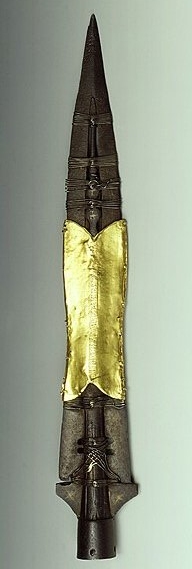
In both battles the Holy Lance played a crucial role. The Lance, said to be the one Centurion Longinus used to pierce Jesus' side on the cross (the blood curing his blindness and convincing him to convert), had been given to Henry by its previous custodian, King Rudolf II of Burgundy.
A hugely significant relic in terms of establishing the credibility of the Ottonians, it was displayed during the sessions of prayer held before both battles.
Wednesday, January 30, 2013
Corporate Sustainability - Face-Saving Window Dressing?
Despite the billions invested in it, few companies' environmental talk is matched by their walk, as business tweeter Ramon Arratia argues in The Corporate Sustainability Beauty Contest on CSRWire.
Arratia argues that company CEO's are deluding themselves about their sustainability credentials:
A 2010 Accenture survey of global CEOs found that 81 percent thought sustainability issues were ‘fully embedded’ into the strategy and operations of their company. They really think that having a CSR team reporting to public affairs with a nicely designed 150k report with some cherry-picked case studies and a set of qualitative targets plus a few quantitative targets on quick wins is ‘fully embedded’!He suggests a three point approach--focusing on the footprint of products rather than the image of companies.
It is a challenge to high-profile PR programmes like last week's announcement of The Global 100: World Leaders in Clean Capitalism (by Corporate Knights), which lists two oil companies in its top 5 and is (unsurprisingly) heavily weighted toward Western, wealthy north European countries.
One of the ironies of growing "environmental awareness" is that--in terms of perceptions--saving the planet has become just another capitalist scam.
Wednesday, March 02, 2011
No More Guttenberg

No more Guttenberg is probably premature as he's likely to be back before long.
After two weeks' kerfuffle about his copy 'n pasting his doctrorate, KT zu Guttenberg wasn't left a lot of options, although Chancellor Merkel seemed happy for him to stay.
But when Professors at your old university start calling you a BetrĂ¼ger (fraud, impostor), when political enemies in your own party are saying how ashamed they are, and the country's tabloids are writing about nothing else, staying on as a minister soon becomes untenable.
If he lies low for a bit and shows a bit of remorse (so ill-suited to his brand before, but necessary now), he'll be well placed to take over in the CSU in Bayern. From there, a bid for the Chancellorship itself is far from unfeasible.
His head-turning popularity among German voters will likely make him think along such lines.
Tuesday, August 31, 2010
White Fright
http://www.slate.com/id/2265515/pagenum/all/#p2
12 Step Sustainability Plan
http://www.sustainability.com/blog/a-twelve-step-program-for-unsustainable-consumption
Thursday, January 21, 2010
Geert Wilders
The most striking aspect of the case is that it is explicitly not about truth. The Dutch ministry has written:
“It is irrelevant whether Wilder’s witnesses might prove Wilders’ observations to be correct, what’s relevant is that his observations are illegal...”
The illegality rests on whether his statements offend Muslims or incite violence against Muslims.
I've pasted the two laws Wilders is alleged to have broken below:
Article 137c Dutch Penal Code
1. He who publicly, verbally or in writing or image, deliberately expresses himself in an way insulting of a group of people because of their race, their religion or belief, or their hetero- or homosexual nature or their physical, mental, or intellectual disabilities, will be punished with a prison sentence of at the most one year or a fine of third category.
2. If the offence is committed by a person who makes it his profession or habit, or by two or more people in association, a prison sentence of at the most two years or a fine of fourth category will be imposed.
Article 137d Dutch Penal Code
1. He who publicly, verbally or in writing or in an image, incites hatred against or discrimination of people or violent behaviour against person or property of people because of their race, their religion or belief, their gender or hetero- or homosexual nature or their physical, mental, or intellectual disabilities, will be punished with a prison sentence of at the most one year or a fine of third category.
2. If the offence is committed by a person who makes it his profession or habit, or by two or more people in association, a prison sentence of at the most two years or a fine of fourth category will be imposed.
Thursday, September 17, 2009
Utopia: Rules with Wiggle-Room
Henninger contrasts the primal world of sports, governed by clearly-defined rules, with real life, in which no one knows the rules anymore.
The problem being that in real life we lack a final arbiter, so that wiggle-room has the tendency to expand, exponentially, each time a rule is challenged.
http://online.wsj.com/article/SB10001424052970204518504574416774102132370.html
Muslim Creationism
http://newhumanist.org.uk/2131
Thursday, November 20, 2008
NATO Spy For Russia Unmasked
Dusseldorf, Germany (CNSNews.com) – A senior Estonian government official is under arrest and being investigated for allegedly passing NATO and European Union secrets to Russia.
A spokesman for Estonia’s Defense Ministry confirmed to CNSNews.com on Wednesday that the man had been “caught for having revealed classified information” and said Estonia had given a “firm commitment to cooperate” with a NATO investigation.
Herman Simm, 61, who was responsible for handling classified and top secret material in the Baltic state’s capital, Tallinn, reportedly had access to “nearly all” documents circulated within NATO and the E.U., the German magazine Spiegel reported.
Simm headed government discussions in bilateral talks on protecting secret data flow.
He was also central to negotiations aimed at protecting the E.U. and NATO’s handling of sensitive information and was in charge of granting security clearances.
Intelligence that may have been compromised includes information relating to the controversial U.S. missile shield plans, a cyber protection program, the response to Russia’s actions in Georgia, and all NATO operations, from Kosovo to Afghanistan.
Simm was allegedly approached to become a Russian “mole” or “sleeper” at the end of the 1980s, Estonian politician Jaanus Rahumaegi, who leads the oversight committee for the government security agency, told Spiegel. At that time Estonia was still part of the Soviet Union.
Later, when the issue of Estonia’s NATO membership came onto the agenda, Simm in the mid-1990s “was officially recruited by the Russian government,” Rahumaegi said.
Estonia joined both NATO and the E.U. in 2004.
As European and NATO investigations proceed, the case is proving a major international embarrassment. The security breach is feared to be the worst since CIA counter-intelligence expert Aldrich Ames was exposed as a Russian spy in the early 1990s.
As of Tuesday, neither NATO nor the E.U. has commented on the case. Neither has a defense lawyer acting on behalf of Simm.
Estonian Ministry of Defense spokesman Martin Jasko said Wednesday that “no country is honoured by the fact that its citizen has been caught for having revealed classified information.”
Speaking on behalf of the government, he said its “firm commitment to co-operate in investigating Simm’s treason proves to NATO that it can be considered a responsible and trustworthy member state. Accordingly, we believe that Estonia’s reputation as a NATO partner is even stronger.”
Simm is said to have used a primitive converted radio transmitter to set up secret meetings with his contact man, known as “The Spaniard” because he posed as a Spanish businessman.
In a throwback to Cold War working practices, Simm operated together with his wife, Heete. A former lawyer in the national police headquarters, she has also been detained, charged with being an accessory to treason.
The Simms were originally detained on Sept. 21, but the case has been kept low-key. They will likely be arraigned early next year.
Herman Simm was a senior figure in the Estonian government. In 1994 he worked as Estonia’s chief of police, and later, he became a department head in the Defense Ministry.
He was in charge of secret coordination between NATO and the E.U.
When Estonia joined the E.U. and NATO, Simm’s value to Russia dramatically increased, as he was on the circulation list for highly sensitive NATO and European material.
An official quoted by Spiegel described Simm as a “big fish” who “gave the Russians practically everything NATO and the E.U. passed between them.”
Simm apparently made a fortune selling military secrets to the Russian Foreign Intelligence Service SVR, the successor to the KGB.
He first drew suspicion to himself when he bought a portfolio of expensive property, including an opulent villa outside Tallinn and a farmhouse on the Baltic Sea.
His contact man then became careless in trying to recruit a second Estonian spy, who promptly reported it to Estonian intelligence. Following the trail of “The Spaniard” led investigators to Simm and his access to sensitive material within NATO.
Russian media reports on the case say it highlights the lack of security of Estonia’s handling of intelligence and sensitive information.
Estonia, described by NATO Secretary General Jaap de Hoop Scheffer as “NATO’s most IT-savvy nation,” is a country of just 1.3 million people. Much government and commercial business is conducted online. People vote and pay taxes on the Internet, and government meetings involve virtually no paperwork.
When Estonia infuriated Russia by removing a Soviet war memorial in 2007, the country faced a vicious wave of Web-based attacks. Estonia has been lobbying hard to put cyber-defense on NATO’s agenda and set up a Cyber Defense Center in Tallinn, which is meant to help the alliance as a whole – a project that may now be compromised.
The ongoing NATO/E.U. investigation is being conducted by NATO’s Office for Security, headed by Michael Evanoff, an American.
Tuesday, November 18, 2008
German Government Likely To Bail Out GM-Subsidiary Opel
Link to my article on CNS News today:
Dusseldorf, Germany (CNSNews.com) – As the global financial crisis lashes the auto industry, Germany’s federal and state governments look set to bail out Opel, a subsidiary of General Motors Corp., with a reported two billion euro ($2.6 billion) rescue package.
Opel’s German management, which requested the aid, is struggling with a cash-flow crisis.
German managers point to failings at GM’s insolvency-threatened U.S. head office in Detroit. They claim they are back-owed billions of dollars in investment. Germany’s GM-Opel management is also considering breaking away from General Motors Corp. should it apply for insolvency. Opel employs more than 25,000 people in the German states of Hessen, Thuringen, North-Rhine Westphalia and Rhineland-Pfalz.
Chancellor Angela Merkel called for an emergency meeting in her office on Monday afternoon to discuss options with GM’s European president, Carl-Peter Forster, GM-Opel chairman Hans Demant, and union boss Klaus Franz. Also attending were Finance Minister Peer Steinbruck and Minister for Economic Affairs Michael Glos.
Proposals on the table include a federal bond or guarantee of around $1 billion. This would be supplemented by another $1 billion guarantee from the four affected German states. The funds are reportedly needed to allow the cash-strapped company to continue manufacturing and to pay its creditors.
Thursday, November 13, 2008
Germany To Obama: No More Troops For Afghanistan
Dusseldorf, Germany (CNSNews.com) – Germany has been effusively supportive of Barack Obama – opinion polls showed he had the backing of 85 percent of the population – but early signs of strain are showing with Chancellor Angela Merkel. She has warned the president-elect that she will turn down any request for more German troops in Afghanistan.
Merkel’s coalition partners in the socialist Social Democratic Party (SPD) are also sounding warning bells. In the build-up to national elections next September, however, the government is downplaying any potential for differences with Obama.
Read the rest of the article here.